Breach news · Weekly digest
The company that lost it was not the one you chose
Everything that joined the public record this week was lost by a firm the affected people had never dealt with directly. One of them reaches British Revolut customers, and what it took was home addresses, employers and ages.
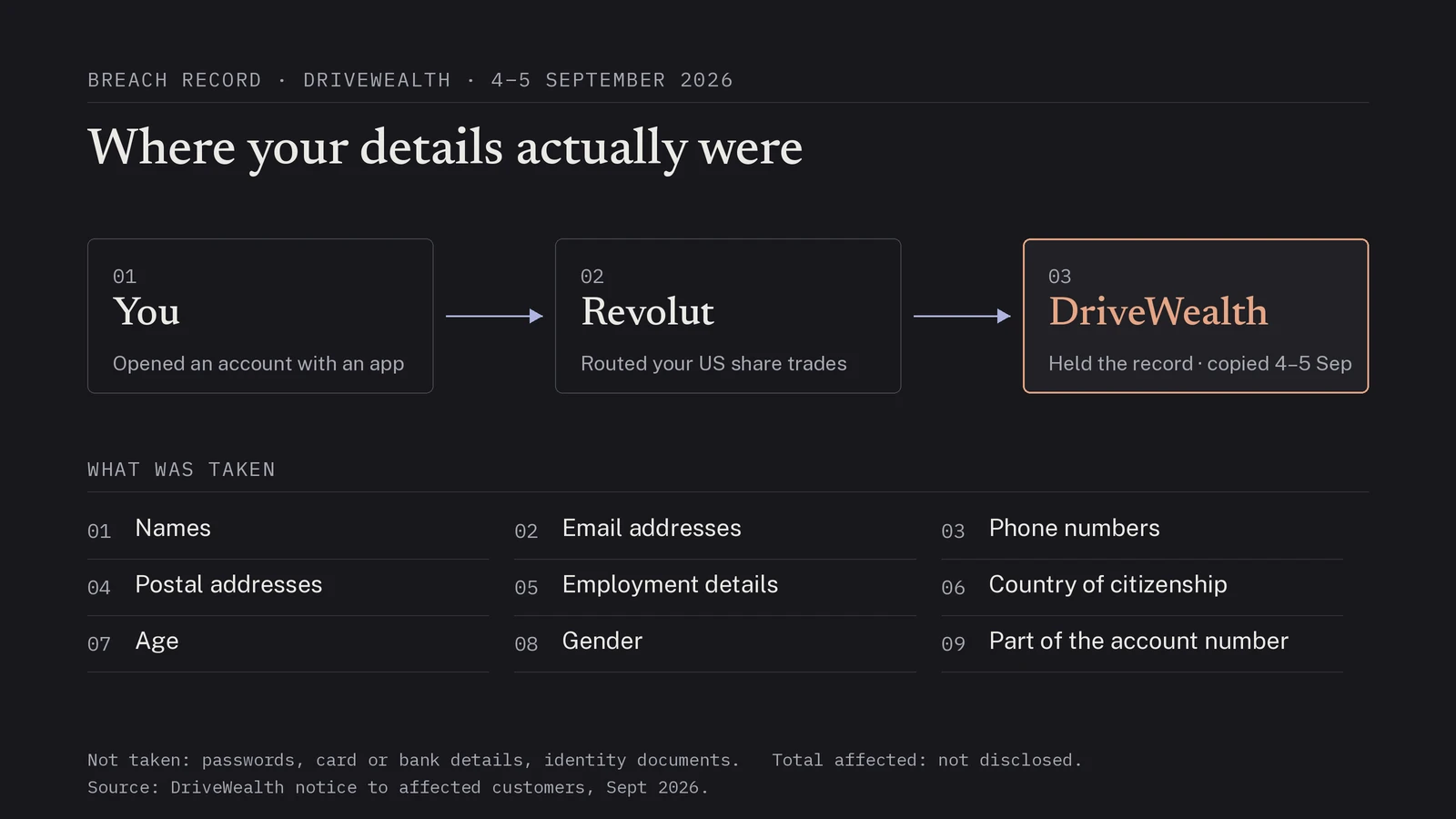
DriveWealth, an American brokerage, told customers this week that an intruder had copied historical account records from its network on 4 and 5 September. Most British people affected have never opened its website. They used Revolut.
Who is in it
DriveWealth carried out US share trades for other people's apps, Revolut among them. If you bought US shares through Revolut under its earlier arrangement, your details sat with DriveWealth rather than with Revolut. Revolut moved customers in the UK, the EEA and Australia off that arrangement between December 2023 and June 2025, the date varying by market, and stopped sending details onward after each migration.
So this exposure is historical by design. It is the record of a relationship that has already ended, and DriveWealth says it was required to keep those records to meet its regulatory obligations. That is the part worth sitting with: closing an account does not empty the filing cabinet, and in a regulated industry it is not meant to.
Neither Revolut nor DriveWealth has published how many customers are affected, and we are not going to estimate it. Where a total has not been disclosed, this piece says so and the figure below leaves it out rather than drawing it as nothing.
What was taken
From the notice sent to affected customers: names, email addresses, phone numbers, postal addresses, employment information, country of citizenship, age, gender, and part of a DriveWealth account number. No passwords. No card or bank details. No identity documents.
- The addresses, employers and ages are the permanent ones. An address cannot be reset, and that particular combination — where you live, who you work for, roughly how old you are — is what a people-search listing is assembled from.
- Country of citizenship and part of an account number are what make an impersonation land. Someone who already knows your address, your employer and the tail of a brokerage account does not sound like a stranger on the phone.
- Nothing here lets anyone sign in or move money. DriveWealth says no trades, transfers or withdrawals were made and that outside investigators found no continuing access. There is no password involved, so we are not going to tell you to change one.
Stake and Hatch customers had more taken than Revolut customers did: tax status and country of taxation for Stake, income and net-asset ranges for Hatch, and for both a snapshot of portfolio value and cash. If you hold one of those accounts, the notice you were sent is not the same notice.
Everything added this week
Below is what the record gained in the seven days to 25 September, including the entries we log from a company's own notice before Have I Been Pwned holds the data. Where a figure is shown it counts account records rather than people: one person with three accounts at the same service appears three times. Treat it as the size of the pile, not the size of the crowd.
- DriveWealth
Exposed email addresses, names, phone numbers, home addresses and employers.
- LimeLeads
Exposed email addresses, employers, locations, job titles and phone numbers.
- Burger King Russia
Exposed dates of birth, email addresses, genders, locations and names.
The rest of the week
LimeLeads was a San Francisco firm, now defunct, that rented out access to a database of business contacts — names, job titles, employers, work numbers. Nobody in it signed up for it; it was compiled about people, from their working lives. It spilled in 2019 because a server was left on the internet with no password on it, and it reached the public record this week, seven years later. The geography in it is American, down to the state and the ZIP code, so a British reader is unlikely to be in this one.
The Burger King Russia entry was not an attack on Burger King Russia. It was an attack on Mindbox, the marketing platform it used, and the data ran from 2018 to August 2024 with dates of birth in it. Russian customers, so again, almost certainly not you.
In every case this week the company that lost the data is not the company the reader dealt with: a clearing broker behind an app, a marketing platform behind a brand, and a firm that never met the people it held records on. That is not a coincidence about this particular week. It is what the arrangement looks like from the inside, and it is why a list of the companies you have accounts with is not a list of the companies holding your details.
What to do about a leaked address
- Treat contact about your investments as unverified for a while, however much the caller appears to know already. End the call and dial the number in the app instead.
- A leaked address does not need resetting. It needs removing from the places that resell it, which is a different job from changing a password, takes longer, and nobody emails you a prompt to start it.
- If you want the organisation to answer for it, the ICO accepts complaints about how a company handled your personal information — including when the company that lost it was its supplier rather than the company you signed up with.
We publish every holder we act against by name, so the claim can be checked rather than taken on trust. Start with the coverage list and see which of them carries a home address.
A scan cannot match the DriveWealth records yet. Account-level matching comes from Have I Been Pwned, which lists a breach only once it holds the data, and it does not hold this one. We have given it a page anyway, sourced from DriveWealth's own notice, because now is when people go looking for it.
What this is based on
- DriveWealth — cyber response notice — The company's own account: the 4–5 September dates, that data was exfiltrated, that no trading or withdrawal activity was found, and that no passwords or payment details were involved. Opened 25 September 2026.
- The Register — another week, another data breach for Revolut customers — The field list as it appeared in the email to affected customers, the social-engineering route in, and the December 2023 to June 2025 window over which Revolut moved UK, EEA and Australian customers off the arrangement.
- Finance Magnates — DriveWealth incident exposes Revolut, Stake and Hatch customer data — What differed between the three platforms, including the tax status and portfolio snapshots taken for Stake and Hatch customers but not for Revolut's.
- Have I Been Pwned — LimeLeads — Date added to the public record, exposed field list and the count of affected addresses.
- ZDNet — 49 million records from US data broker LimeLeads put up for sale — The original 2020 reporting: an Elasticsearch server left without a password, found by a researcher who notified the company, and the field list including city, state and ZIP.
- Have I Been Pwned — Burger King Russia — Date added, exposed field list, and the 2018 to August 2024 span of the data.
- The Register — 3.2M Burger King Russia customers — That the attack was on the Mindbox marketing platform, and Burger King Russia's own statement on what was not included.
- ICO — make a complaint about how an organisation used your personal information — The UK route to complain, and what the ICO can and cannot do about it.
Write back
If something here was wrong, unclear, or you know more than we do, reply to support@nullivo.com. A person reads every one.
We publish some replies on the article. Nothing goes up without you saying yes first, and it appears under a nickname you pick rather than your name — we take out anything that would identify you. The community rules set out what we will and will not print.
Added since this went out
Breach news →- Assurance Retraite70,000 accounts2026-10-20
- Gîtes de France118,000 accounts2026-10-18
- Crunchbase560,000 accounts2026-10-14
- Sharecare318,000 accounts2026-10-12
- Neogen436,000 accounts2026-10-09